Hedge cutting: nesting bird season, the High Hedges Act and neighbour disputes
A hedge is cut for two reasons, shape and size, and the timing for each is not the same. Add the species, the law on nesting birds and the question of whose hedge it is, and a job that looks like a Saturday afternoon with the trimmer turns out to have more rules than most garden tasks. None of them is difficult, but ignoring them is how hedges end up brown, bare at the base, or the subject of a council complaint.
In short: Most hedges in the UK are best cut in late summer, August to early September, once the main growth has finished, with formal hedges getting an extra trim in late spring. Avoid cutting between March and August unless you have checked carefully for active nests, which are protected by law. Never cut conifers back into brown wood. If a neighbour's evergreen hedge over 2 m tall is blocking your light, the High Hedges Act allows a complaint to the council, but only after you have tried to resolve it directly.
The cutting calendar by hedge type
| Hedge | Main cut | Extra cuts | Notes |
|---|---|---|---|
| Leylandii, Lawson cypress, Thuja | Late July to August | A light trim in late spring if needed | Never cut into brown wood; it does not regrow. Keep below 2 m for ease and to avoid the High Hedges Act |
| Yew | August to September | None usually | Will regrow from old wood, so can be renovated hard in late winter |
| Privet, Lonicera nitida, box | May to September, every 4 to 8 weeks for a crisp finish | Fast-growing; a once-a-year cut leaves them shaggy. Box: watch for box blight and caterpillar | |
| Beech, hornbeam | August | A tidy in winter if needed | Cut in August keeps the brown leaves on over winter |
| Holly, Portuguese laurel, cherry laurel | August | Use secateurs or a hedge trimmer with sharp blades on laurel to avoid torn leaves browning | |
| Hawthorn, blackthorn, mixed native | January to February, every one to two years | Winter cutting keeps berries for birds through autumn; cut outside the nesting season | |
| Flowering hedges (forsythia, escallonia, Rosa rugosa, lavender) | Straight after flowering | Cutting at other times removes next year's flowers |
Cutting in late summer, after growth has slowed, means the hedge stays tidy until the following year with one cut. Cutting in spring stimulates regrowth and the job needs repeating. For hedges that are to be reduced in height or renovated rather than trimmed, late winter (February to early March) is the time, before the nesting season and while the plant is dormant, and only for species that regrow from old wood.
Nesting birds: the law
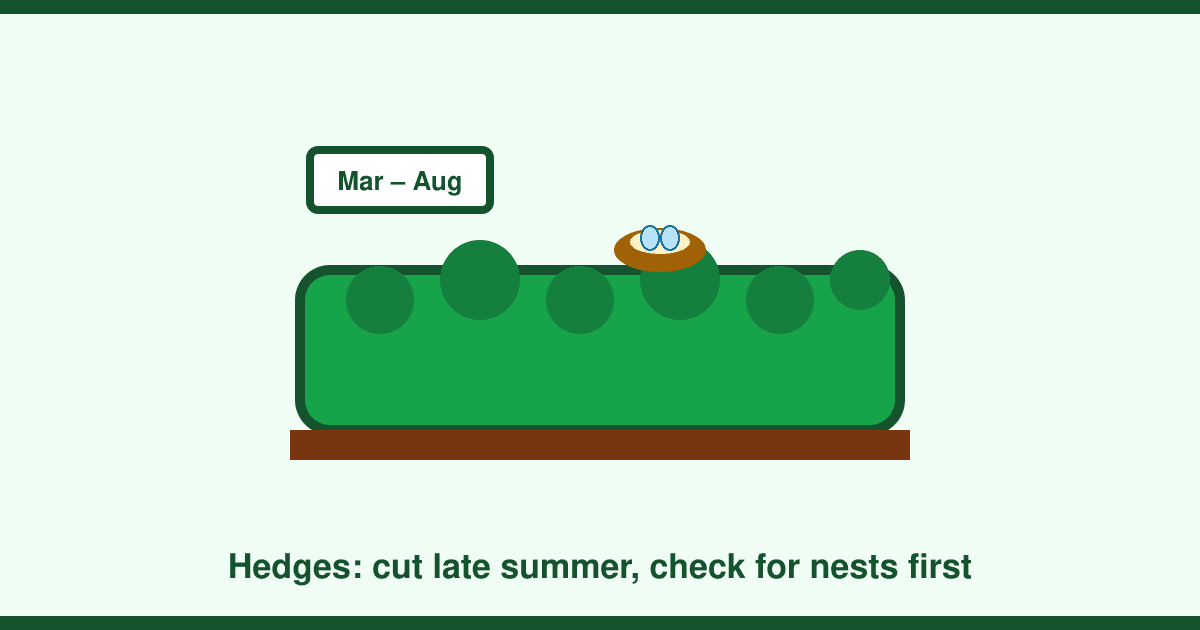
Under the Wildlife and Countryside Act 1981 it is an offence to intentionally or recklessly damage or destroy the nest of any wild bird while it is in use or being built. Hedges are prime nesting habitat, and the bird nesting season runs from roughly March to August, with some species starting in February and finishing in September. The RSPB and Natural England advise against cutting hedges in that period. If a hedge must be cut during the season, for safety or access, inspect it closely first, and stop if you find a nest with eggs or chicks. For farmers and land managers, the Hedgerow Regulations include a specific ban on cutting agricultural hedgerows between 1 March and 31 August; garden hedges are not covered by that rule but the nest protection applies to everyone.
The practical consequence is that the serious cutting happens in the window between late August and the end of February, which conveniently matches the best horticultural timing for most species.
Cutting technique
Cut the sides with a slight batter, wider at the base than the top, so light reaches the lower growth and the hedge stays leafy to the ground; a hedge cut vertical or wider at the top goes bare at the base within a few years. Run a string line along the top for a level finish. Sharp blades matter: blunt trimmers tear leaves, which brown. Clear the clippings from the base, where they harbour disease. On a tall hedge, use a platform rather than a ladder, which is where most hedge-trimming injuries happen.
A badly overgrown hedge is reduced in stages: one side in the first winter, the other side the next, and the top in a third, so the plant is never without foliage. Conifers cannot be renovated this way; a leylandii cut back to brown wood stays brown.
The High Hedges Act
Part 8 of the Anti-social Behaviour Act 2003, usually called the High Hedges Act, applies in England and Wales (Scotland has the High Hedges (Scotland) Act 2013 and Northern Ireland its own 2011 Act). It lets the occupier of a domestic property complain to the council about a neighbour's hedge if it is:
- made up of a line of two or more evergreen or semi-evergreen trees or shrubs;
- more than 2 m tall; and
- a barrier to light or access that adversely affects the reasonable enjoyment of the complainant's property.
Deciduous hedges and single trees are outside the Act. The council will not take a complaint until you can show you have tried to resolve the matter with the neighbour, usually by a letter, and most councils charge a fee for a complaint, typically between £300 and £700, which is not refunded if the complaint fails. If the council finds the hedge is a problem, it issues a remedial notice requiring the owner to reduce it, normally not below 2 m, and failure to comply is an offence. The Act does not require any hedge to be kept below 2 m in the absence of a complaint, and a hedge that is tall but not blocking light is not covered.
Your neighbour's hedge, your side
You may cut back branches and roots of a neighbour's hedge or tree that overhang or grow into your property, up to the boundary, without permission, but not beyond it. The cuttings remain the neighbour's property and should be offered back rather than dumped over the fence. You cannot cut the hedge's height from your side. If the hedge or tree is subject to a Tree Preservation Order or stands in a conservation area, even cutting overhanging branches needs consent, as our guide to TPOs explains. For boundary hedges, where the hedge is owned jointly, both parties should agree before any major cutting.
Most disputes are avoided by a conversation before the trimmer comes out. Where a hedge needs reducing substantially, a shared cost for a gardener or tree surgeon to do it properly, with the hedge cut to a height both sides accept, is cheaper than a council complaint and better for the relationship. Hedge cutting is priced by the metre or the hour; our guide to what gardeners charge gives the usual range.
Sources: Wildlife and Countryside Act 1981, section 1; RSPB guidance on hedge cutting and nesting birds; Anti-social Behaviour Act 2003, Part 8, and the Ministry of Housing, Communities and Local Government guide "High hedges: complaining to the council"; High Hedges (Scotland) Act 2013; Royal Horticultural Society guidance on hedge trimming, renovation and timing by species; Hedgerow Regulations and Defra guidance on hedgerow management rules for farmers. Council complaint fees vary; check your local authority's current charge.
Frequently asked questions
Late summer, August to early September, for most hedges, once the main growth has finished; formal fast-growing hedges such as privet get extra trims from May. Native hedges are cut in winter, flowering hedges straight after flowering, and renovation work is done in late winter before the nesting season.
Not in itself, but it is an offence under the Wildlife and Countryside Act 1981 to damage or destroy an active bird’s nest, and hedges are nesting habitat from March to August. Avoid cutting in that period, or inspect carefully first and stop if you find a nest. Farmers face a specific ban on cutting agricultural hedgerows from 1 March to 31 August.
There is no general height limit. The High Hedges Act lets a neighbour complain to the council about an evergreen or semi-evergreen hedge over 2 m that blocks their light or access; the council can then order it reduced, usually not below 2 m. Deciduous hedges and single trees are not covered.
Yes, back to the boundary line but not beyond it, and you cannot reduce its height from your side. The cuttings still belong to the neighbour and should be offered back, not thrown over the fence. If the hedge or tree is protected by a TPO or is in a conservation area, you need consent even for overhanging branches.
Not into brown wood: conifers such as leylandii do not regrow from old wood and a hard cut leaves permanent brown patches. Trim only the green growth, once a year in late summer, and keep the hedge at the height you want from the start. Yew is the exception among conifers and can be renovated hard in late winter.