Tree Preservation Orders explained: when you need permission to prune or fell a tree
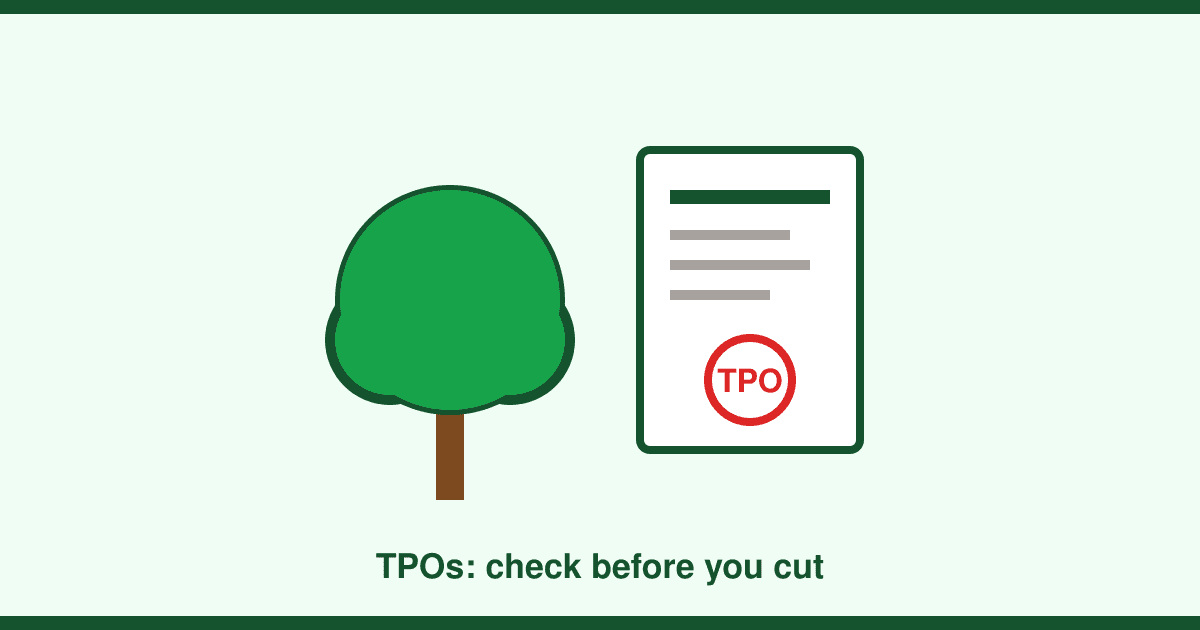
Most people find out that a tree is protected in one of two ways: by checking before they cut it, or by receiving a letter from the council afterwards. The second route is expensive. A Tree Preservation Order (TPO) is not a planning technicality; wilfully damaging or destroying a protected tree is a criminal offence with an unlimited fine in the Crown Court, and the council can require a replacement tree on top. The good news is that checking takes a few minutes and consent, where it is needed, is free to apply for.
In short: A TPO is made by the local planning authority and protects a specific tree, group or woodland. Any pruning, topping, lopping, uprooting or felling needs the council's written consent, applied for on the standard form and decided within eight weeks. Trees in a conservation area need six weeks' notice to the council before work, even without a TPO. Exceptions cover dead and dangerous trees and some fruit trees, but you must be able to prove the exception applies. Check with your council's planning department or online TPO map before any work.
What a TPO does
In England and Wales, TPOs are made under the Town and Country Planning Act 1990 and the Town and Country Planning (Tree Preservation) (England) Regulations 2012; Scotland and Northern Ireland have their own equivalent legislation. A TPO can cover a single tree, a group, an area or a woodland, and it attaches to the land, so it stays in force when the property changes hands. It protects all species, including hedgerow trees, but not hedges, bushes or shrubs as such.
Once a TPO is in place, you need consent for anything that would cut the tree: pruning branches, reducing or thinning the crown, cutting roots, topping or felling. There is no minimum size of branch. Routine work on a protected tree such as removing a few small branches still needs consent unless an exception applies.
How to check whether a tree is protected
Most councils publish a TPO map on their planning website, searchable by address, and all will confirm by email or phone to their tree officer. If you are buying a house, TPOs appear in the local land charges search your solicitor carries out. Previous planning applications on the property often include a tree survey. Conservation area boundaries are also mapped by the council.
Do not rely on a neighbour's recollection or on the fact that the previous owner pruned the tree without trouble. If you hire a tree surgeon, a reputable one will ask about TPOs and will often check for you, but the legal responsibility sits with the owner and anyone who carries out the work.
Applying for consent
Consent is applied for on the standard national form, available on the Planning Portal or from the council, and there is no fee. You describe the work (for example, crown reduction by 2 m, removal of two low limbs over the drive) and give the reasons, with photographs. The council has eight weeks to decide, and can grant consent, grant it with conditions such as replanting, or refuse. A refusal can be appealed to the Planning Inspectorate. Applications for felling need stronger justification than pruning, such as evidence of disease, structural failure or subsidence damage from a qualified arboriculturist or engineer.
For work in a conservation area on a tree without a TPO, you give the council six weeks' notice under section 211 of the Act, describing the work. The council can either let the six weeks pass, in which case you may proceed, or make a TPO in that time. Trees in conservation areas with a trunk diameter under 75 mm measured at 1.5 m above ground are exempt from the notice requirement.
The exceptions
| Situation | Rule |
|---|---|
| Tree is dead | Exempt, but give the council five days' notice unless it is an immediate danger; a replacement tree may be required |
| Tree is dangerous | Work needed to remove an immediate risk is exempt; be ready to prove it, with photographs and ideally a written report |
| Fruit tree grown for fruit | Pruning in line with good horticultural practice is exempt on cultivated fruit trees; felling is not |
| Planning permission granted | Trees whose removal is necessary to implement a detailed planning permission are exempt, as set out in that permission |
| Statutory undertakers | Utility companies and similar bodies have limited exemptions for their operations |
| Nuisance | There is an exemption for work to prevent or abate a legal nuisance, but it is narrow and courts have interpreted it strictly; take advice before relying on it |
"Dangerous" is the exemption most often misused. A tree that drops twigs in the wind, blocks light or has roots lifting a path is not dangerous in the legal sense. Councils investigate, and an owner who felled a healthy protected tree claiming it was dangerous faces prosecution.
Penalties
Deliberately destroying a protected tree, or damaging it so badly it is likely to be destroyed, carries a fine of up to £20,000 in the magistrates' court and an unlimited fine in the Crown Court, where the court can also take account of any financial benefit from the offence, such as an improved view or a development plot. Lesser offences such as unauthorised pruning carry fines of up to £2,500. On top of the fine, the owner is normally required to plant a replacement tree of an appropriate size and species in the same place.
Felling licences and hedgerows
Separate from TPOs, felling more than 5 cubic metres of timber in any calendar quarter needs a felling licence from the Forestry Commission (or Natural Resources Wales or Scottish Forestry), but trees in gardens are exempt from this requirement. Countryside hedgerows over 20 m long are protected by the Hedgerow Regulations 1997 and need six weeks' notice to the council before removal; garden hedges are not covered. Nesting birds are protected everywhere under the Wildlife and Countryside Act 1981, which rules out most tree work between March and August regardless of TPO status.
Working with a tree surgeon
A competent tree surgeon will check for protection, advise on what work is likely to get consent, prepare the application and, for felling, provide the written justification the council expects. That advice is part of what you pay for; our guide to tree surgery costs explains how work is priced, and you can compare tree surgeons in your area in our listings. Be cautious of anyone willing to start work on a tree without asking whether it is protected.
Sources: Town and Country Planning Act 1990, sections 198 to 214; Town and Country Planning (Tree Preservation) (England) Regulations 2012; Ministry of Housing, Communities and Local Government, Planning Practice Guidance on tree preservation orders and trees in conservation areas; Forestry Commission guidance on felling licences; Hedgerow Regulations 1997; Wildlife and Countryside Act 1981. Rules in Scotland and Northern Ireland differ in detail; check with the relevant council.
Frequently asked questions
Check your council’s online TPO map or ask its tree officer by email, which is free. TPOs also appear in the local land charges search done when you buy a property, and in any previous tree survey submitted with planning applications on the house. Conservation area boundaries are mapped by the council too.
No. Any pruning, crown reduction, root cutting, topping or felling needs the council’s written consent unless an exception applies, such as the tree being dead or an immediate danger, or routine pruning of a fruit tree grown for fruit. Apply on the standard form; there is no fee and the council has eight weeks to decide.
Up to £20,000 in the magistrates’ court, or an unlimited fine in the Crown Court, which can also take account of any financial gain from the felling. Unauthorised pruning carries fines of up to £2,500. The owner is also normally required to plant a replacement tree.
Yes, if the trunk is 75 mm or more in diameter at 1.5 m above the ground. You must give the council six weeks’ written notice describing the work. The council can let the period expire, after which you may proceed, or make a TPO in that time.
Work needed to remove an immediate risk is exempt, but the exemption is narrow and you must be able to prove the danger, ideally with photographs and a written report from an arboriculturist. A tree that merely blocks light or drops twigs is not dangerous in the legal sense. For a dead tree, give the council five days’ notice unless there is an immediate danger.