Low maintenance garden ideas that actually work in the UK climate
Every garden needs some work; the question is how much, and how much of it is pleasant. A low-maintenance garden removes the chores that are relentless, such as weeding bare soil, mowing a scrappy lawn, watering pots and cutting back fast-growing hedges, and keeps the ones that are occasional and satisfying. The ideas below are the ones that hold up over years in the UK's wet winters and increasingly dry summers, rather than the ones that look good in a magazine for a season.
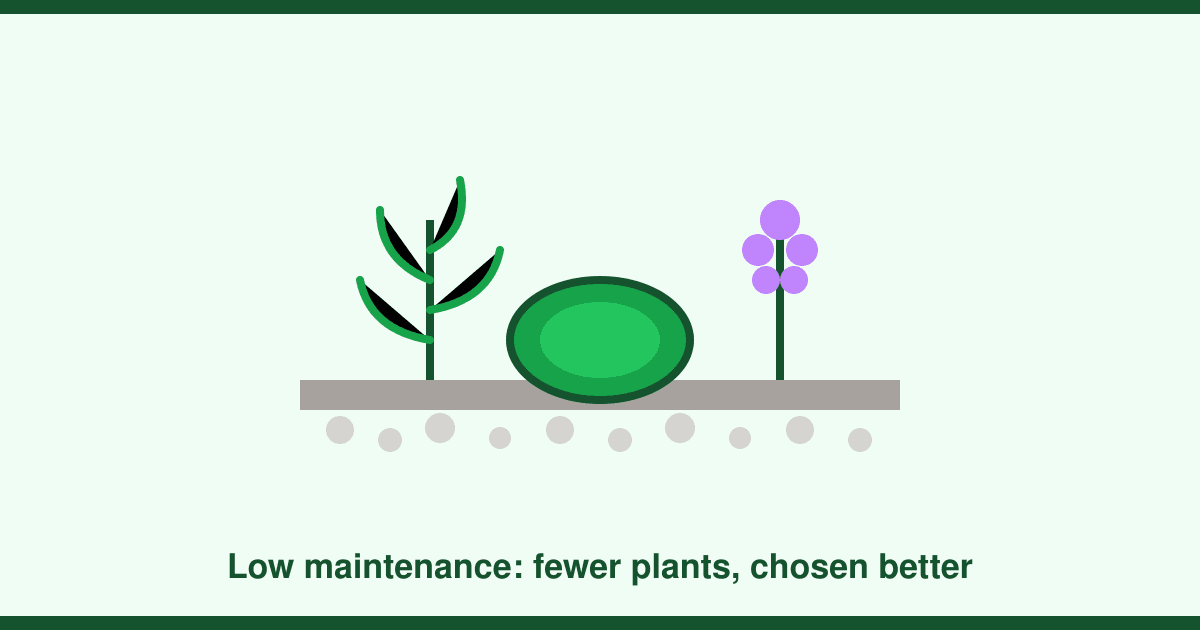
In short: Cover every patch of soil with mulch or plants so weeds have nowhere to start. Choose shrubs, perennials and grasses suited to your soil and light, and plant them densely. Shrink the lawn or replace it with something that needs no mowing. Pick slow-growing hedges and hard surfaces that drain. Fit a simple irrigation system if you must have pots. And accept that a garden with no work at all is a car park.
Start with the soil you cannot see
The single largest source of garden work is bare soil. Bare soil grows weeds, dries out, needs digging and needs watering. The low-maintenance principle is simple: never leave it bare. Mulch every bed with 5 to 8 cm of bark, composted woodchip or well-rotted compost, topped up every couple of years, and plant closely enough that within two or three seasons the plants themselves cover the ground. Weeding then drops to a few minutes a month of pulling out seedlings from loose mulch.
Dig once, properly, when you make the bed, then stop digging. Disturbed soil brings weed seeds to the surface; undisturbed, mulched soil does not.
Plants that look after themselves
"Right plant, right place" is the Royal Horticultural Society's phrase, and it is the whole secret. A plant suited to its soil and light needs no feeding, no watering once established and no cosseting. Three groups do most of the work:
| Group | Why it is low maintenance | Examples for UK gardens |
|---|---|---|
| Evergreen and structural shrubs | Permanent framework, one light prune a year, no replanting | Viburnum tinus, Choisya, Pittosporum, Sarcococca, Euonymus, Osmanthus, Hebe, dwarf pines |
| Hardy perennials and grasses | Come back every year, cut down once in late winter, cover the ground | Geranium 'Rozanne', Nepeta, Alchemilla, Hemerocallis, Persicaria, Stipa tenuissima, Miscanthus, Hakonechloa |
| Ground cover | Suppresses weeds, no edging, no bare soil | Vinca minor, Epimedium, Pachysandra, Bergenia, Ajuga, creeping thyme in sun, ferns in shade |
What to avoid: annual bedding, which has to be bought, planted, watered and removed twice a year; most roses, which need pruning, feeding and disease control; vigorous climbers such as wisteria and vines that need pruning twice a year; and anything described as "fast-growing", which is a promise of regular cutting back.
The lawn question
A lawn is the most demanding element of most gardens: weekly mowing from March to October, edging, feeding, moss control. The options, in increasing order of change:
- Shrink it to the area you actually use, and widen the borders; mowing time falls in proportion.
- Simplify the edges. A mowing strip of paving or bricks set level with the lawn removes edging altogether and lets the mower run over it.
- Let it grow. A mown path through longer grass, cut two or three times a year, or a clover-rich lawn that stays green without feeding, is far less work and better for wildlife. Wildflower meadows are not low maintenance in the first years, whatever the seed packet says.
- Replace it with gravel over a membrane, a terrace, or a planted bed. Artificial grass removes mowing but still needs brushing and cleaning, gets hot in summer and is increasingly discouraged for its effect on soil life and drainage.
Hard surfaces and water
Paths and terraces are the one part of a garden that needs almost no care, provided they drain. Permeable surfaces, including gravel, resin-bound aggregate, permeable block paving and paving laid with open joints on a free-draining base, avoid puddles, moss and the planning rules that apply to impermeable front gardens (over 5 square metres of non-permeable paving at the front of a house needs planning permission in England). Gravel laid 4 to 5 cm deep over a weed-suppressing membrane is the cheapest and, raked once in a while, among the lowest maintenance of all.
Pots are the exception to everything above. A pot needs watering daily in summer. If you want pots, use large ones, which dry out slowly, fit a simple drip irrigation kit on a tap timer, and accept that or do without.
Hedges and boundaries
A leylandii hedge needs cutting twice a year and punishes neglect. Slower hedges, such as yew, holly, beech, hornbeam and Portuguese laurel, need one cut a year and tolerate being left; a mixed native hedge needs cutting once every year or two in winter. Fences need no cutting but do need treating; a fence covered by a self-clinging evergreen such as climbing hydrangea or a trained Pyracantha disappears and needs little. Our guide to when to cut hedges covers timing and the law.
What is left
Even a well-designed low-maintenance garden has a calendar: cutting perennials and grasses down in February, a light prune of shrubs after flowering, topping up mulch every other year, a hedge cut in late summer, sweeping leaves off paving in autumn. That amounts to a few days a year rather than a few hours a week, and it is the kind of work that can easily be handed to a gardener on a seasonal visit. For a garden being redesigned around these principles, a landscaper will do the one-off work of mulching, planting densely and laying the hard surfaces, and the design pays for itself in the years of work it saves. Our seasonal maintenance calendar shows how little is left once the design does the heavy lifting.
Sources: Royal Horticultural Society, guidance on right plant right place, mulching, ground cover planting and low-maintenance gardening; Planning Portal, guidance on paving front gardens and permeable surfaces; Plantlife and RHS guidance on reduced mowing and clover lawns; Met Office UK climate summaries on wetter winters and drier summers. Plant suitability varies with soil and exposure; check hardiness ratings for your area.
Frequently asked questions
Dense planting of shrubs, perennials and ground cover over a deep mulch so no soil is bare, a small lawn or none, permeable gravel or paving for surfaces, slow-growing hedges and no pots. That reduces work to a few days a year: cutting back perennials in late winter, one hedge cut, a light shrub prune and topping up mulch.
Evergreen structural shrubs such as Viburnum tinus, Choisya, Pittosporum and Sarcococca; hardy perennials and grasses such as Geranium ‘Rozanne’, Nepeta, Alchemilla and Stipa; and ground cover such as Vinca, Epimedium and Bergenia. Choose them for your soil and light and plant densely. Avoid annual bedding, most roses and anything sold as fast-growing.
It removes mowing but still needs brushing, washing and weed removal at the edges, gets hot in summer, and is increasingly discouraged because it smothers soil life and sheds microplastics. Shrinking the lawn, adding a mowing strip or letting part of it grow long are cheaper and better for the garden.
Never leave soil bare. Mulch beds 5 to 8 cm deep with bark or compost, plant closely so the plants cover the ground within a few seasons, and stop digging, which brings weed seeds to the surface. Lay gravel over a membrane on paths. Weeding then becomes pulling the odd seedling from loose mulch.
In England, paving more than 5 square metres of a front garden with an impermeable surface needs planning permission. Permeable surfaces such as gravel, permeable block paving or paving that drains to a lawn or border do not, and they also avoid puddles and moss.