How to get rid of ivy from walls, fences and trees without making it worse
English ivy (Hedera helix) is one of the most useful plants in a British garden and one of the most resented. It feeds late-season bees, shelters wrens and gives blackbirds winter berries, and it will also lift roof tiles, swallow a fence and turn a small tree into a sail. Whether to remove it is a judgement; how to remove it is a technique, and getting the technique wrong is what leaves people fighting the same ivy for years.
In short: Cut every ivy stem through at the base and, where it is on a wall or tree, leave the upper growth to die for several weeks before pulling it, so the aerial roots release rather than tearing the surface. Dig out the rooted base, and go back for regrowth. Weedkiller alone rarely works on ivy because of its waxy leaves. Check for nesting birds between March and August before you start, and think twice about removing ivy from a sound wall at all.
Does ivy actually damage walls?
On sound brick or stone with hard mortar, research for English Heritage found that ivy generally does little harm and can even protect the surface from frost and temperature swings. Its aerial roots cling to the surface but do not penetrate it. The damage happens where there is already a weakness: old lime mortar, cracked render, loose pointing, gaps around windows and under roof tiles, where stems work their way in and thicken. Ivy on a timber fence or a shed holds moisture against the wood and shortens its life; ivy growing into guttering blocks it.
So the first question is whether removal is needed. A mature ivy on a sound garden wall, trimmed back from the roofline and windows once a year, is often the best outcome for the wall and for wildlife.
Removing ivy from a wall or fence
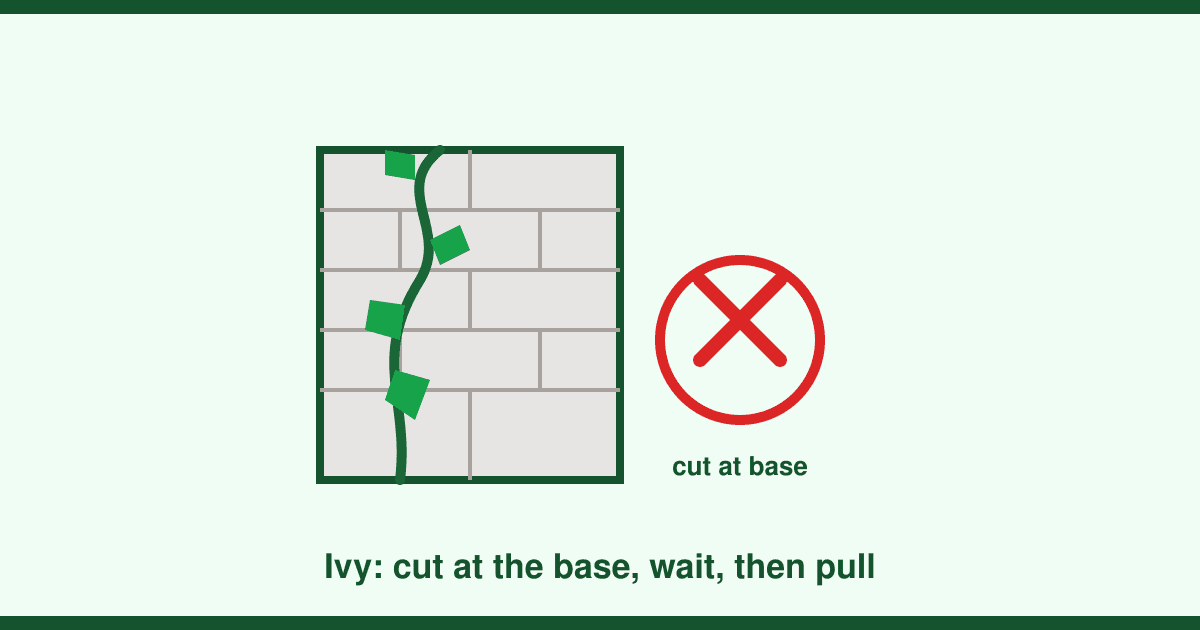
- Cut the stems at the base, as low as you can, with loppers or a pruning saw. On old plants the main stems can be as thick as a wrist.
- Wait. Leave the growth above the cut for three to six weeks in summer, longer in winter. As it dies, the aerial roots loosen their grip and the leaves drop, which makes the next step far easier and does less damage to the surface.
- Pull the dead growth away from the top down, working in sections. On render or soft brick, go slowly; tearing live ivy off takes the surface with it.
- Deal with the residue. The dead root hairs left on brickwork can be brushed with a stiff brush once fully dry, and some will weather off over a year. Wire brushing wet residue smears it. On painted surfaces, expect to repaint.
- Dig out the base. Ivy regrows readily from stumps and from the roots that have run along the foot of the wall. Dig out as much as you can, then check every few weeks for new shoots and remove them with their roots.
Removing ivy from a tree
Ivy is not a parasite and does not take nutrients from a tree. The concern on a mature tree is weight and wind resistance in the crown, and on an older or weakened tree ivy can hide decay and make inspection difficult. The approach is the same as for a wall but with one strong rule: never try to rip ivy out of a tree's canopy. Cut a section about 30 cm long out of every stem at the base of the trunk, treat the lower cut surfaces if you intend to use a herbicide, and leave everything above to die in place. It will drop over the following year or two. Pulling live ivy from branches strips bark and brings down dead wood.
For a large tree, or where the stems are thick and the tree is near a building, this is a job for a tree surgeon, who will also check the tree's condition. If the tree is subject to a Tree Preservation Order, cutting ivy from it is not controlled, but any pruning of the tree itself is.
Ivy in beds and on the ground
Ground-covering ivy spreads by rooting wherever its stems touch soil. Cutting it back only tidies it. Dig out the rooted stems with a fork, working systematically from one edge, and remove every piece of stem, since fragments can root. Covering the area with thick cardboard and mulch, or black plastic, for a full growing season will kill most of what you miss. Expect to go back over the ground a few times in the following year.
Does weedkiller work on ivy?
Poorly. The waxy leaf surface sheds most sprays. Glyphosate has some effect if the leaves are bruised or crushed first and the plant is actively growing, and a tough-weed formulation containing triclopyr does better, but neither replaces cutting and digging. The most effective use of herbicide is on the freshly cut stump of a thick stem, applied immediately so it is drawn into the roots. Follow the label, keep spray off anything you want to keep, and avoid treating ivy that is in flower, when it is covered in insects.
Timing and the law
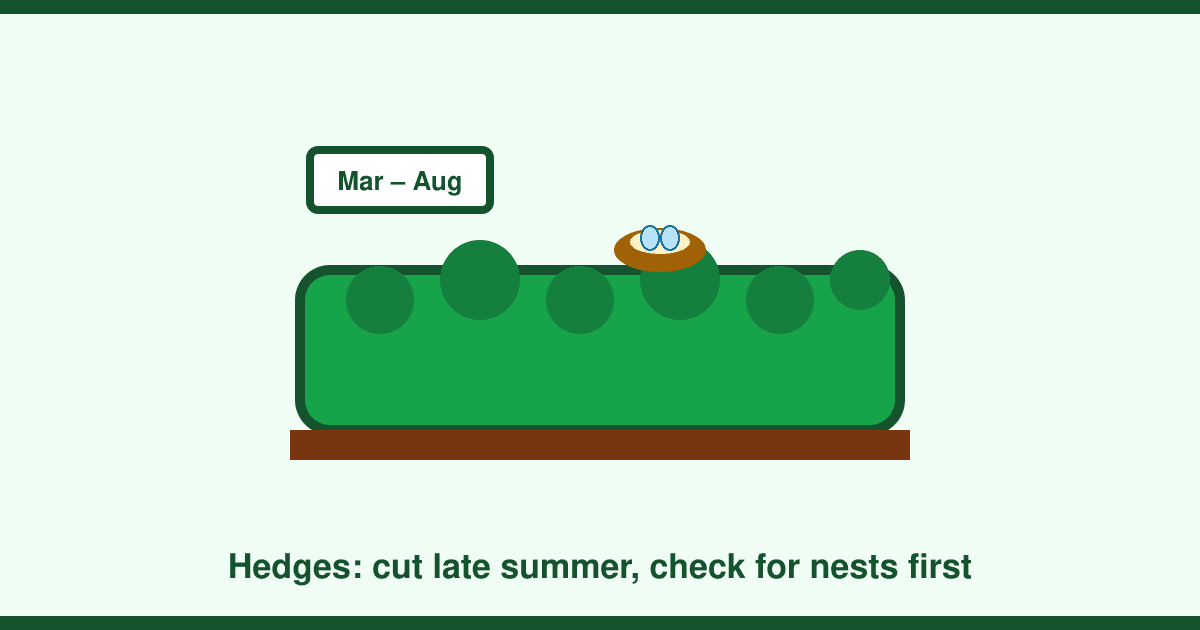
Ivy is a valuable nesting site, and under the Wildlife and Countryside Act 1981 it is an offence to damage or destroy an active bird's nest. The safe practice is to avoid clearing dense ivy between March and August. If you must work in that period, check the ivy carefully for nests first and stop if you find one. Ivy flowers in September and October and its berries ripen over winter, so autumn and early winter clearance also removes food that birds and insects were relying on. Where you can, leave some ivy somewhere in the garden.
Removed ivy is bulky and slow to compost. Shred it if you can; otherwise it goes in garden waste collections or to the tip. For a large clearance, a gardener with a shredder and a trailer can save you several trips, and most local gardeners will quote for ivy removal as a fixed job rather than by the hour.
Sources: English Heritage and University of Oxford research on the effects of ivy on historic walls; Royal Horticultural Society guidance on ivy as a weed and on controlling it; Wildlife and Countryside Act 1981 (protection of nesting birds); RSPB advice on ivy and wildlife; Health and Safety Executive guidance on garden herbicides and label compliance.
Frequently asked questions
On sound brickwork with hard mortar, generally no; research for English Heritage found ivy can even protect the surface. Damage happens where there is an existing weakness such as old lime mortar, cracked render, loose pointing or gaps under roof tiles, where stems get in and thicken. Timber fences and sheds do suffer because ivy holds moisture against the wood.
Cut every stem at the base, leave the upper growth to die, then dig out the rooted base and remove regrowth whenever it appears. Herbicide on its own rarely works because of the waxy leaves; the most effective use is applying a tough-weed product to the freshly cut stump of thick stems.
No. Cut a 30 cm section out of every stem at the base of the trunk and leave the growth above to die and drop over a year or two. Pulling live ivy out of a canopy strips bark and brings down dead branches. For large trees, use a tree surgeon.
It is not illegal to remove ivy, but it is an offence under the Wildlife and Countryside Act 1981 to damage or destroy an active bird’s nest, and ivy is a favoured nesting site. Avoid clearing dense ivy between March and August, or check thoroughly for nests and stop if you find one.
Wait until the dead growth and the remaining root hairs are completely dry, then use a stiff dry brush. Scrubbing while damp smears the residue. Some marks weather away over a year; on painted surfaces, plan to repaint once the wall is clean and dry.