How to level a lawn or a sloping garden: from top-dressing to terracing
"Level the garden" covers everything from a lawn that catches the mower on a few humps to a back garden that drops two metres from the house to the fence. The methods, the cost and the risks are completely different, and the most common mistake is applying a lawn-levelling technique, such as piling on topsoil, to a problem that needs structural work, or hiring a digger for something a rake and a few bags of sandy loam would have solved.
In short: For minor bumps and hollows in an established lawn, top-dress with a sandy loam mix in thin layers in spring or autumn and let the grass grow through. For deeper hollows and humps, lift the turf, adjust the soil and relay it. For a sloping garden, choose between a gentle regrade, which needs somewhere for the soil to go, and terracing with retaining walls, which holds the levels but costs more and may need planning permission and structural design above about one metre.
Minor lumps and hollows: top-dressing
Most lawn unevenness is a matter of a centimetre or two: settlement over old trenches, worm casts, ant hills, the tracks of a wheelbarrow in a wet winter. Top-dressing fixes it gradually. Mix roughly three parts sharp sand, three parts sandy loam or topsoil and one part compost, or buy a ready-made lawn dressing, and spread it over the hollows no more than 1 cm deep at a time, working it in with the back of a rake or a lute so the grass tips show through. Repeat every few weeks in the growing season until level. Burying grass under more than about 1 cm in one go kills it.
Spring (April to May) and early autumn (September) are the times to do this, when the grass is growing strongly and will knit through the dressing. Combine it with aeration and overseeding and you have the standard lawn renovation routine.
Deeper hollows and humps: lift and relay
For a hollow deeper than 2 to 3 cm, or a hump, cut an H shape through the turf over the spot with a half-moon edger, peel back the two flaps, add or remove soil beneath, firm it with your feet, and fold the turf back. Water well and keep off it for a couple of weeks. The same technique deals with the ridge left by a buried pipe or the dip where a stump has rotted. If the problem is widespread, with a quarter of the lawn affected, it is often quicker to strip the turf, regrade the whole area and lay new turf or seed.
A sloping garden: regrade or terrace?
| Approach | Suits | Pros | Cons |
|---|---|---|---|
| Gentle regrade (cut and fill) | Slopes under about 1 in 10, where soil can be moved from the high side to the low side | Single level, cheapest structural option, no walls | Needs somewhere for surplus soil, exposes subsoil on the cut side, changes drainage |
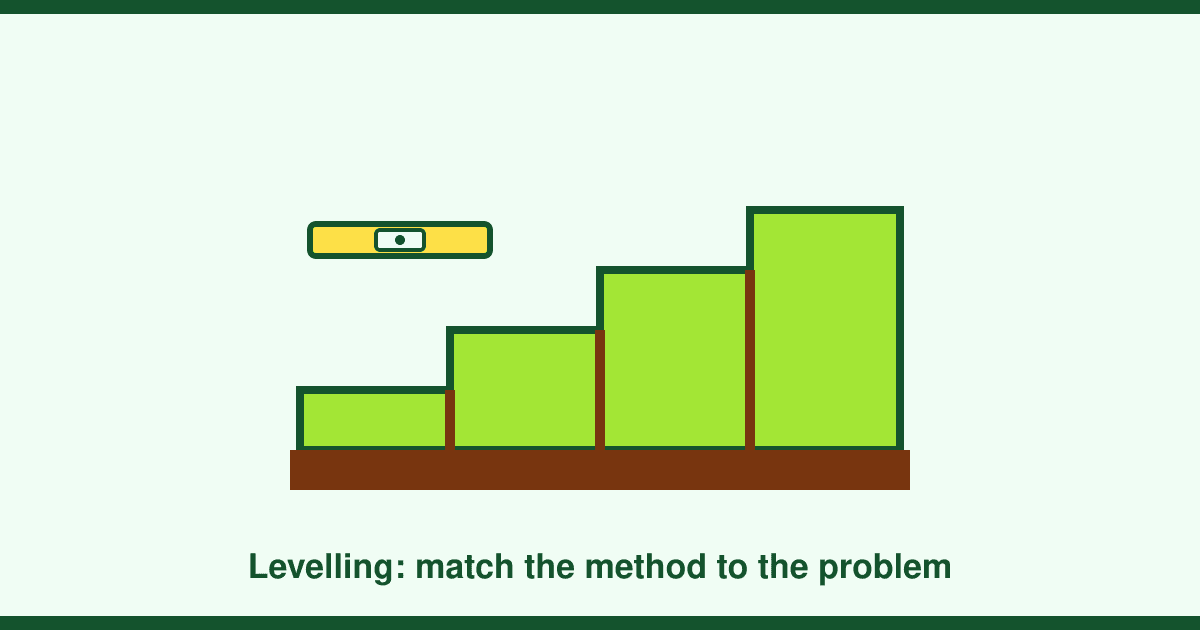
| Terracing with retaining walls | Steeper slopes, where you want usable flat areas | Creates level lawns, patios and beds; walls can be timber sleepers, blocks, gabions or stone | Walls over about 1 m need structural design and drainage; cost rises with wall height |
| Grading to a gentle slope and accepting it | Lawns and planting | Cheapest of all; mowers cope with gentle slopes | No flat areas for seating or play |
| Decking or raised platform | Seating area on a slope | Avoids moving soil at all | Timber maintenance, not a solution for the whole garden |
Two things decide it. The first is where the soil goes: regrading a 100 square metre garden by 50 cm moves 50 cubic metres of soil, which is five or six grab-lorry loads if it leaves the site and a serious amount of digging if it does not. The second is what sits at the boundaries. You cannot raise the ground against a neighbour's fence or a house wall without consequences: fences rot, damp-proof courses are bridged (soil must stay at least 150 mm below the DPC) and surface water heads for the neighbour. Retaining walls hold the level change inside your own boundary.
Retaining walls, planning and structure
A retaining wall holds back a wedge of wet soil, and the force on it increases sharply with height. As a working rule, walls up to about 600 mm can be built as a straightforward landscaping job in sleepers or blockwork with a drainage layer behind; walls approaching 1 m and above should be designed by a structural engineer, with proper foundations, weep holes or a drainage pipe behind, and a geotextile to keep soil out of the drainage. Walls that fail do so slowly and expensively.
Planning permission is usually not needed for garden walls under 2 m, or under 1 m where the wall is next to a highway, but any change of ground levels close to a boundary, a wall that affects a neighbour's support or a wall in a conservation area can need consent. Building Regulations do not generally cover free-standing garden walls, but a retaining wall supporting a building or a public path is a different matter. A quick check with the council's planning department before work starts is cheap insurance. Where a wall sits on or near the boundary, the Party Wall etc. Act 1996 may require notice to the neighbour before excavation.
Drainage, services and what the ground is made of
Changing levels changes where water goes. Every terrace needs a slight fall away from buildings, and the low point needs somewhere to drain: a soakaway, a land drain to a ditch, or a connection to surface water drainage. Before any digging, locate services; gas, water, electricity and telecoms can run across a back garden, and drains certainly do. Clay soil shrinks and swells with moisture and heavy regrading near a house can affect foundations, which is a reason to keep significant level changes away from the building and to take advice if the house is on shrinkable clay.
What it costs
Top-dressing a lawn costs tens of pounds in materials. Lifting and relaying turf in a few places is a day's work for one person. Regrading a small garden with a mini-digger, including hire or a landscaper's day rate and soil disposal, runs into the low thousands; terracing with retaining walls starts at a few thousand pounds for a single low sleeper wall and rises steeply with height, length and the choice of stone or rendered blockwork. Our guide to garden landscaping costs sets out typical figures, and you can compare landscapers who do groundworks in our listings. For anything involving walls above knee height, ask to see similar work they have built, and ask who is doing the structural design.
Sources: Royal Horticultural Society, guidance on lawn top-dressing and repairing lawns; Planning Portal, guidance on permitted development for fences, gates and garden walls and on changes of ground level; Party Wall etc. Act 1996 explanatory booklet (Ministry of Housing, Communities and Local Government); NHBC guidance on ground levels and damp-proof courses (minimum 150 mm); Institution of Structural Engineers guidance on domestic retaining walls. Costs are indicative national ranges and vary with access, soil and region.
Frequently asked questions
Top-dress it. Spread a sandy loam mix over the hollows no more than 1 cm deep at a time, work it in so the grass tips show through, and repeat every few weeks in spring or early autumn until level. Deeper hollows or humps are fixed by cutting an H in the turf, peeling it back, adjusting the soil beneath and relaying.
April to May or September, when the grass is growing strongly and will knit through the top-dressing. Avoid summer drought and winter, when the grass cannot recover and the dressing sits on the surface.
Usually not for modest regrading or garden walls under 2 m (1 m next to a highway), but significant changes of ground level near a boundary, walls affecting a neighbour’s support, and work in conservation areas can need consent, and the Party Wall Act may require notice to neighbours before excavating near the boundary. Check with the council first.
As a working rule, walls up to about 600 mm can be built as a landscaping job with a proper drainage layer behind. Walls approaching 1 m and above should be designed by a structural engineer, with foundations, drainage and a geotextile, because the force from wet soil rises sharply with height.
Not against the house: soil must stay at least 150 mm below the damp-proof course or you risk damp inside. Raising ground against a neighbour’s fence rots it and pushes surface water onto their land, which can make you liable. Use a retaining wall inside your own boundary to hold the level change.