How to get rid of moss and bring a tired lawn back: scarifying, aerating and overseeding
By late summer many British lawns are more moss than grass: spongy underfoot, yellow-green in patches, thin where the ground is shaded or where feet take the same route to the shed. A moss killer will turn it black in a fortnight and raking will fill several sacks, and if that is all you do, the moss will be back by the following spring. Moss grows where grass is struggling, and the point of a lawn renovation is to change the conditions so that grass wins.
In short: Treat moss with a lawn moss killer, wait two weeks for it to blacken, then scarify to remove it and the thatch beneath, aerate compacted areas, top-dress and overseed, and feed with an autumn lawn fertiliser. Do this in September or early October, or in April. Then fix the cause: raise the mowing height, improve drainage, let in more light, and feed the lawn regularly.
Why moss takes over
Moss has no roots to speak of and cannot compete with vigorous grass. It wins when the grass is weakened by one or more of the following:
| Cause | How to recognise it | Fix |
|---|---|---|
| Shade | Moss worst under trees, beside fences and on the north side of the house | Thin or raise tree canopies, choose shade-tolerant seed mixes, accept a smaller lawn |
| Compaction | Water sits after rain; a fork is hard to push in; moss along paths and play areas | Hollow-tine aerate in autumn, top-dress with sandy loam |
| Poor drainage | Lawn stays wet for days; moss in low spots | Aeration, sand top-dressing, in severe cases land drains or a French drain |
| Low fertility | Pale, slow-growing grass that is never fed | Spring and autumn lawn feeds |
| Mowing too short | Scalped patches, moss in a fine lawn cut below 2.5 cm | Raise the cut; most family lawns do best at 3 to 4 cm |
| Acid soil | Moss with pale grass on sandy or peaty soils | Soil test; apply garden lime only if the pH is below about 5.5 |
A quick test: push a garden fork into the lawn in several places. If it will not go in easily to the depth of the tines, compaction is at least part of the problem.
The right order of jobs
Doing the steps in the wrong order wastes effort. Scarifying live moss spreads it; overseeding before scarifying buries the seed in thatch.
- Apply moss killer. Products based on iron sulphate (ferrous sulphate), either alone or in a combined autumn lawn feed, are the standard. Apply at the label rate on a still day when rain is not forecast for a few hours. Within one to two weeks the moss turns black.
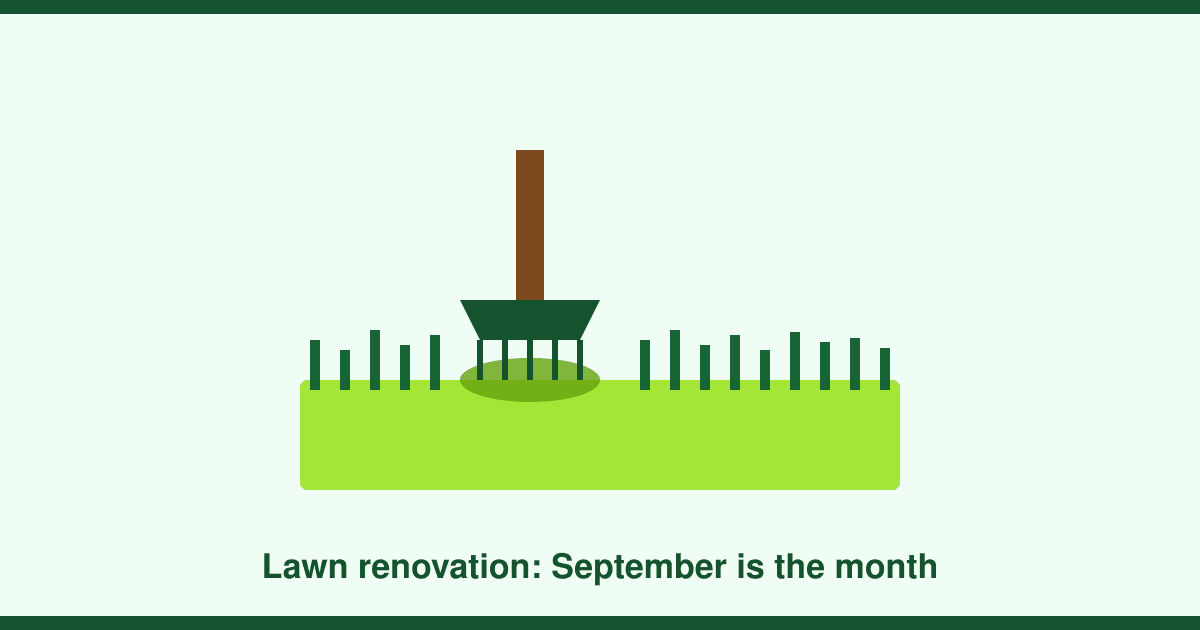
- Scarify. Rake out the dead moss and the layer of thatch (dead grass stems and roots) beneath it. For a small lawn a spring-tine rake is enough; for anything larger, hire a powered scarifier and make two passes at right angles. The lawn will look wrecked. That is normal.
- Aerate. On compacted areas, use a hollow-tine aerator, which removes plugs of soil, rather than a solid-tine or spiked shoes, which only compress the soil around the hole. Sweep up the plugs. Do this every two or three years on heavy soils.
- Top-dress. Brush a thin layer, no more than 1 cm, of sandy loam into the holes and over thin areas. This improves the surface and gives the seed something to root into.
- Overseed. Sow grass seed at around 25 to 35 g per square metre over the whole lawn, heavier on bare patches, choosing a mix that suits the use: hard-wearing ryegrass blends for family lawns, fescue and bent mixes for fine lawns, shade mixes under trees. Rake lightly to work the seed in and keep it moist until it germinates, usually seven to fourteen days in September.
- Feed. Apply an autumn lawn fertiliser, which is low in nitrogen and higher in potassium and phosphorus, to strengthen roots over winter without forcing soft growth. In spring, switch to a high-nitrogen feed.
When to do it
September to early October is the best window in most of the UK: the soil is warm, rain is reliable, weed seeds are less active than in spring, and the grass has months to thicken before next summer. April is the second choice, with the risk that a dry May leaves new seedlings struggling. Avoid scarifying in summer, when the lawn cannot recover, or in winter, when the grass is dormant and the bare soil sits open to moss and weeds.
If you cannot do everything, moss killer, scarifying and an autumn feed in September will get you most of the way, with aeration and overseeding added the following year.
Keeping moss out
The renovation buys you a year; the maintenance keeps it. Mow regularly but never shorter than 3 cm on an ordinary lawn, and raise the cut in shade and in dry weather. Feed in spring and autumn. Rake up leaves promptly in autumn, since a blanket of leaves kills the grass beneath within weeks. In deep shade, consider giving up on grass altogether and planting ground cover or laying a path; a lawn that is 60 per cent moss under a tree will never be anything else.
A full renovation of a medium lawn is a long day's work with hired equipment, and it is one of the jobs where professional help is worth considering. Many gardeners offer autumn lawn treatments as a fixed-price package, and the seasonal calendar shows how it fits with the rest of the autumn jobs. If a lawn is beyond saving, with more weeds and moss than grass across the whole area, it is often quicker to start again with seed or new turf.
Sources: Royal Horticultural Society, guidance on lawn moss, scarifying, aerating and autumn lawn care; Lawn Association guidance on mowing heights and seasonal feeding; product label rates for ferrous sulphate moss killers and grass seed sowing rates from UK seed suppliers. Timings assume a typical lowland UK lawn; in Scotland and upland areas the autumn window closes by late September.
Frequently asked questions
September to early October, when the soil is warm, rain is reliable and the grass has months to recover before summer. April is the second choice. Avoid summer, when the lawn cannot recover from the stress, and winter, when bare soil sits open to moss and weeds.
Before. Apply an iron sulphate moss killer, wait one to two weeks until the moss has blackened, and then scarify. Raking out live moss spreads its fragments across the lawn.
Because the underlying cause has not changed. Moss grows where grass is weak: shade, compaction, poor drainage, low fertility, mowing too short or acid soil. Killing the moss without aerating, feeding, raising the mowing height or letting in more light means it returns within a season.
Around 25 to 35 g per square metre over the whole lawn, and up to 50 g on bare patches. Choose a hard-wearing ryegrass mix for family lawns, a fescue and bent mix for fine lawns, and a shade mix under trees. Keep the seed moist until it germinates, usually within two weeks in September.
Autumn feeds are low in nitrogen and high in potassium and phosphorus, strengthening roots over winter without forcing soft growth that frost would damage. Spring feeds are high in nitrogen to drive leaf growth. Using a spring feed in autumn produces weak, lush growth and more disease.