Japanese knotweed: how to identify it, what the law requires and what removal costs
No other weed in the UK carries the baggage of Japanese knotweed. It is mentioned on the property information form when you sell a house, mortgage lenders ask about it, and a single rhizome fragment the size of a fingernail can start a new stand. Much of what circulates about it is exaggerated: it does not grow through solid concrete and it rarely damages a sound building. But it does spread, it is expensive to remove and it is a recognised legal nuisance, so recognising it early and dealing with it properly matters.
In short: Japanese knotweed (Reynoutria japonica) has hollow, bamboo-like stems with purple speckles, zig-zag stems with shield-shaped leaves, and cream flower tassels in late summer. It is not an offence to have it, but it is an offence to cause it to spread, and all cut material and contaminated soil is controlled waste. Lenders generally require a professional management plan with an insurance-backed guarantee before lending on an affected property. Professional herbicide programmes typically cost £1,500 to £4,000 over three to five years; excavation runs from around £5,000 to well over £20,000.
How to identify it
Knotweed changes through the year, which is why it is often missed:
- Spring (March to April): red or purple shoots like asparagus spears emerge from the crown, growing fast, up to several centimetres a day.
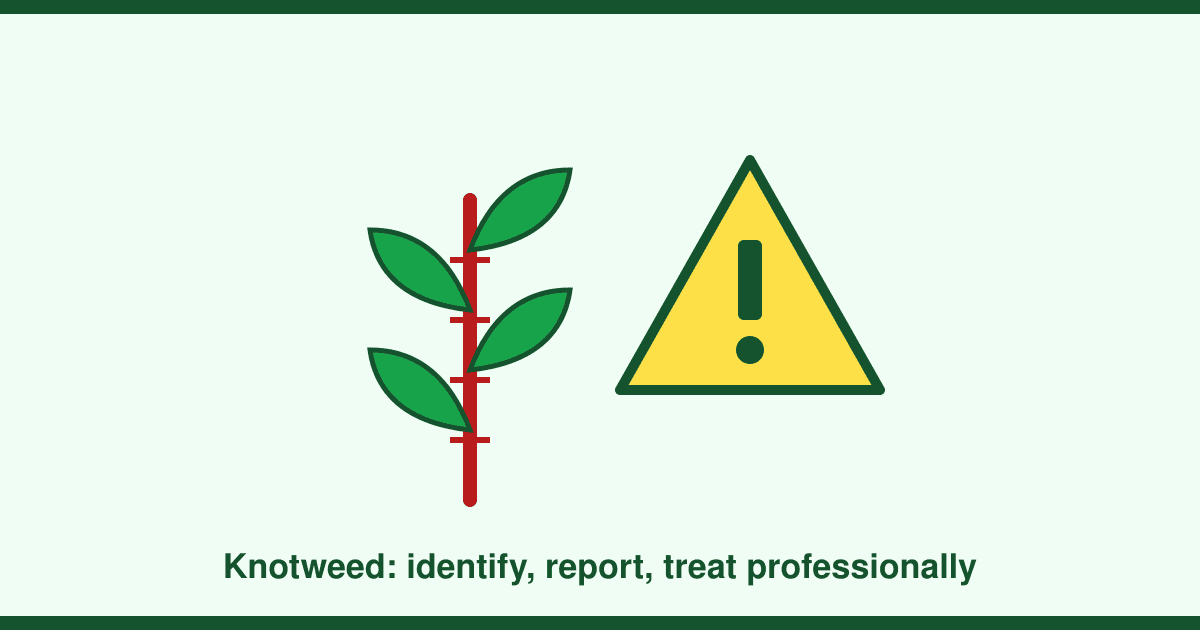
- Summer: hollow green stems with purple flecks, like bamboo, reaching 2 to 3 m, growing in a zig-zag with a heart- or shield-shaped leaf with a flat base at each node. Leaves are arranged alternately along the stem.
- Late August to September: sprays of small creamy-white flowers.
- Winter: the stems die back to hollow brown canes that stand through winter; the crown and rhizomes beneath remain alive.
It is commonly confused with bindweed (a twining climber), Russian vine, Himalayan balsam, dogwood and lilac suckers. If in doubt, several specialist firms and the Property Care Association offer free identification from photographs. Do not dig it up to check; disturbing the rhizome spreads it.
The legal position
Having knotweed on your land is not an offence. Under the Wildlife and Countryside Act 1981 (Schedule 9), it is an offence to plant it or otherwise cause it to grow in the wild, which includes allowing it to spread from your garden onto a neighbour's land or public land through carelessness. Councils and police can also issue community protection notices under the Anti-social Behaviour, Crime and Policing Act 2014 requiring an owner to control it.
Cut stems, crowns, rhizomes and any soil containing them are controlled waste under the Environmental Protection Act 1990. They cannot go in garden waste collections, be composted or be taken to an ordinary tip; they must be disposed of at a licensed landfill by a registered waste carrier, or buried or treated on site under the Environment Agency's guidance. A fly-tipped bag of knotweed is a criminal matter.
Civil liability has grown through the courts. In Williams v Network Rail (2018) the Court of Appeal confirmed that allowing knotweed to encroach on a neighbour's land is an actionable private nuisance, and later cases have awarded damages for loss of value and the cost of treatment. If knotweed is spreading from a neighbour's garden into yours, a written request to treat it, followed if necessary by legal advice, is the route.
Selling, buying and mortgaging
The TA6 property information form asks sellers whether the property is affected by Japanese knotweed. Answering "no" when you know otherwise, or "not known" when you should have known, has led to successful misrepresentation claims. Surveyors flag knotweed in valuation reports, and most lenders will then require a management plan from a specialist contractor, usually with a ten-year insurance-backed guarantee, before they lend. RICS updated its guidance in 2022, replacing the old seven-metre rule with a risk-based assessment of whether the plant is likely to affect the building and amenity, which has made lending more flexible on properties where the stand is small or distant.
Treatment options and costs
| Option | How it works | Timescale | Typical cost |
|---|---|---|---|
| Professional herbicide programme | Glyphosate-based treatment by stem injection or foliar spray, repeated each growing season until no regrowth; monitoring afterwards | 3 to 5 years | £1,500 to £4,000 for a typical garden stand, including a management plan and guarantee |
| Excavation and removal (dig and dump) | Rhizome-contaminated soil dug out, often to 2 to 3 m depth and 7 m laterally, and taken to licensed landfill | Days to weeks, immediate result | £5,000 to £20,000+, driven by soil volume and landfill charges |
| On-site burial or cell | Contaminated soil buried at depth under a root barrier membrane on the same site | Weeks | Cheaper than removal off site where space allows; needs Environment Agency compliance |
| Root barrier membranes | Vertical membrane to stop spread from a neighbouring stand | Days | Hundreds to low thousands; a containment measure, not a cure |
| DIY glyphosate | Repeated application to foliage or cut stems | Many years, often unsuccessful | Product cost only |
Herbicide treatment is the usual choice for gardens where there is no immediate development or sale, and excavation where a quick, certifiable result is needed, for example before building works or completion. "Eradication" in a treatment context means no regrowth over a monitoring period; rhizomes can stay dormant for years, which is why guarantees matter.
Why not DIY?
Cutting, strimming or mowing knotweed scatters fragments that root. Digging spreads rhizome through the soil and produces controlled waste you cannot legally dispose of. Over-the-counter glyphosate applied by hand will weaken a stand over several years but rarely kills it, and the knotweed often responds by producing small, bonsai-like growth that is harder to treat and easy to miss. If you do nothing else, do not let a general gardener or landscaper dig it out, and do not move soil from the area anywhere else in the garden.
Choose a contractor who is a member of the Property Care Association's Invasive Weed Control Group or the Invasive Non-Native Specialists Association, who will provide a written management plan and, if you need it for lending, an insurance-backed guarantee. Our tree surgeon and gardener listings include firms that will identify knotweed and refer you to a specialist, and our guide on choosing a tree surgeon covers the accreditation questions that apply equally here.
Sources: Wildlife and Countryside Act 1981, Schedule 9; Environmental Protection Act 1990 (controlled waste) and Environment Agency guidance on treating and disposing of invasive non-native plants; Anti-social Behaviour, Crime and Policing Act 2014 (community protection notices); RICS, Japanese knotweed and residential property (2022); Law Society TA6 property information form; Williams and Waistell v Network Rail Infrastructure Ltd [2018] EWCA Civ 1514; Property Care Association guidance on treatment and guarantees. Costs are indicative national ranges from specialist contractors' published pricing and vary with the size of the stand and site access.
Frequently asked questions
No. It is an offence to cause it to spread into the wild or onto neighbouring land, to dispose of it other than as controlled waste, and a council can serve a community protection notice requiring you to control it. Allowing it to spread into a neighbour’s garden can also make you liable for damages as a private nuisance.
Look for hollow, bamboo-like stems with purple speckles growing in a zig-zag, with a shield-shaped leaf with a flat base at each node, creamy-white flower tassels in late summer, and red asparagus-like shoots in spring. In winter it leaves hollow brown canes. Specialist firms will identify it from photographs for free; do not dig it up to check.
A professional herbicide programme over three to five years typically costs £1,500 to £4,000 for a garden stand, including a management plan and insurance-backed guarantee. Excavation and removal to licensed landfill gives an immediate result but costs from around £5,000 to over £20,000 depending on the volume of contaminated soil.
Usually, yes, if there is a professional management plan in place, normally with a ten-year insurance-backed guarantee from a specialist contractor. Since RICS updated its guidance in 2022, lenders assess the actual risk to the building rather than applying a blanket seven-metre rule, which has made small or distant stands less of an obstacle.
Repeated glyphosate will weaken it over several years but rarely eradicates it, and the plant often responds with small, hard-to-spot growth. Never cut, strim, mow or dig it, since fragments root and the waste cannot legally go in garden bins. For a property sale or mortgage you will need a specialist’s plan and guarantee in any case.